
Special education law
Haas Education Law
Courtney had already paid for a website once. It went live, she hated it, and she put it behind a maintenance page and stopped looking at it. By the time she found me on Upwork she was not sure who was hosting it or how to get back in. I told her on the first call why that site failed instead of offering to patch it, and that is why she hired me. Six weeks later she had a new brand, a new seven page site, and an intake form that actually reaches her inbox.
- 98 PageSpeed, desktop
- 100 SEO and Best Practices
- 6 wks Kickoff to launch
- WordPress
- Elementor Pro
The problem
Courtney Haas runs a four person special education law firm in New York. Her team represents parents of kids with disabilities against school districts: IEP disputes, mediation, due process hearings, State Review Office appeals. The work is high stakes and deeply personal. Courtney is also the parent of a child with a rare genetic disorder, so she has been on both sides of the table.
Her business is almost entirely referral based. She was not looking for traffic. She needed a website that would not lose the referral once it arrived.
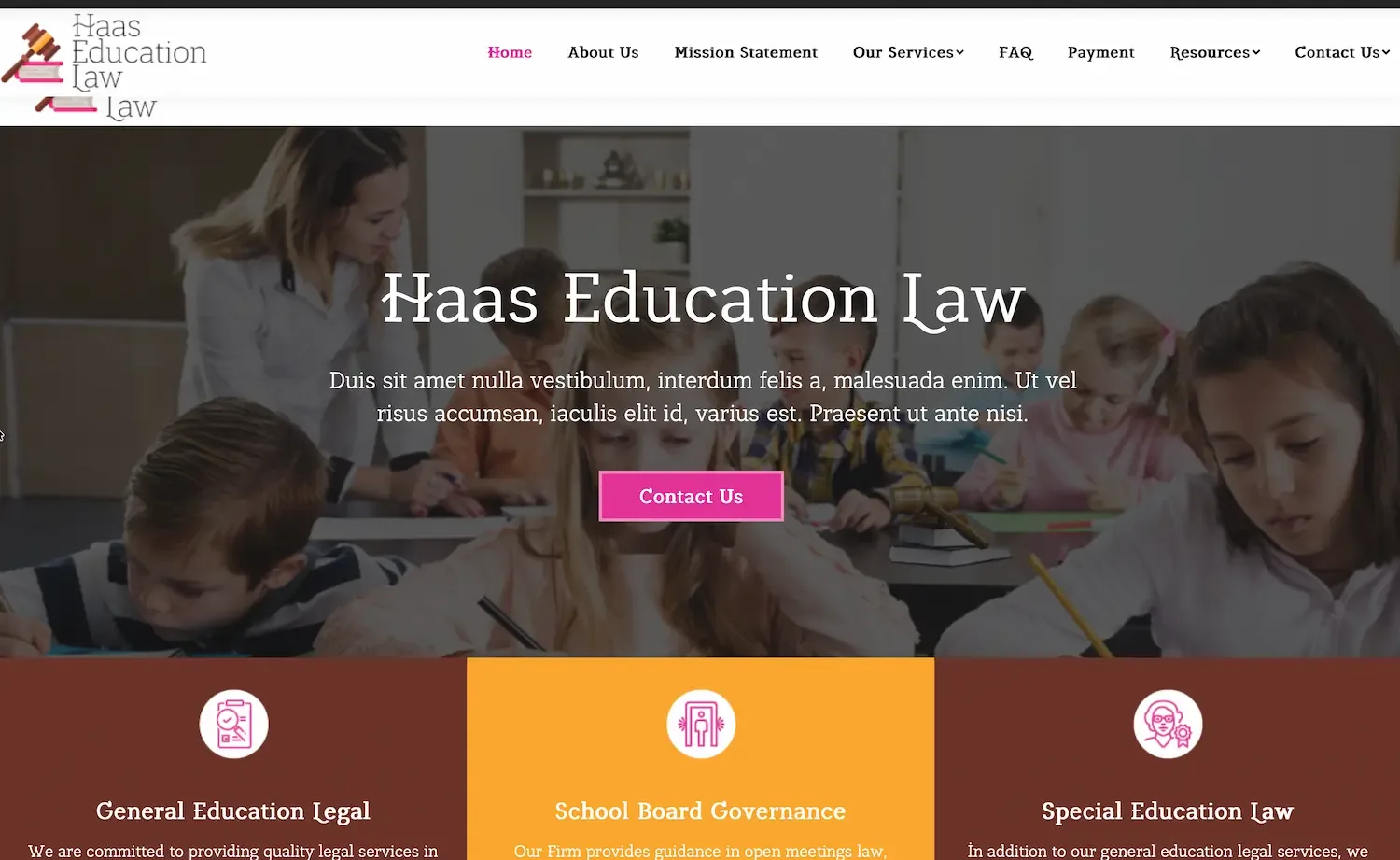
The site she had was doing the opposite. It was hidden behind a maintenance page, which is its own kind of answer. The logo was a gavel sitting on a textbook, and it read as clip art rather than as a mark for a firm handling federal disability law. There was no privacy policy, no terms, no accessibility statement, and no analytics of any kind.
But the real problem was not any of that. It was the audience. The old site was written and designed for a law firm audience. The actual visitor is a parent who just received an IEP notice, does not know what half the words mean, and is reading on a phone at midnight while their kid sleeps. That person is not evaluating credentials. They are trying to find out whether anyone can help them and whether calling will cost anything.
There is also a specific irony worth naming. For a firm whose entire client base is disabled children and their families, an inaccessible website is not a compliance checkbox. It is a credibility problem.
The approach
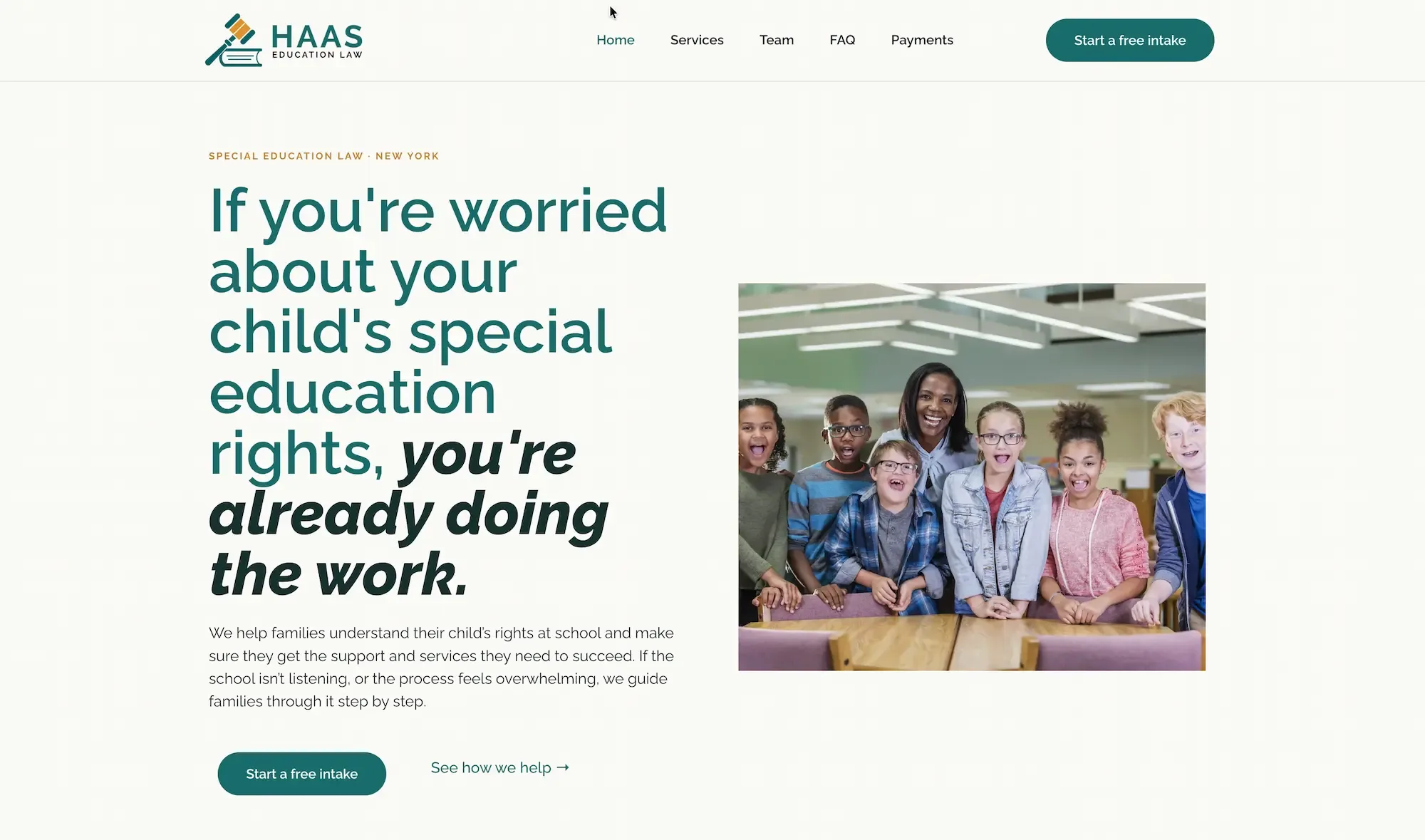
I started with brand, not layout. The direction was warm and parent centered rather than courtroom centered. Deep teal and warm gold, Raleway in bold and light. The voice guide had a side by side of how the firm should sound and how it should not, which became the reference point every time the copy started drifting toward 'pursuant to IDEA.' She approved it in one round.
I kept the gavel and book in the logo because the metaphor is actually right for education law. The execution was the problem, not the concept. I rebuilt the mark from scratch in Illustrator so it reads as a real identity instead of an icon pulled off a shelf.
Then I wrote the copy. Every line was written for the parent, not the bar association. No 'passionate advocates.' No 'fighting for justice.' The headline on the homepage is 'If you're worried about your child's special education rights, you're already doing the work,' because that is what that parent needs to hear before anything else. The services page is organized by where the family is in the process, not by practice area. The FAQ answers the questions that come up on almost every intake call, including the one nobody wants to ask out loud, which is what this costs.
I designed the homepage first and treated it as the visual system for everything else. The remaining pages were built from that system rather than designed as six more separate PDFs.
Two practical calls kept the project moving. Team headshots were flagged as a risk on day one, so I designed with placeholders and swapped real photos in as the last step, which meant the launch date never depended on four busy people booking a photographer. And rather than wait on hosting credentials, I built the entire site on my own staging server and migrated it with Duplicator once Courtney gave the green light.
Before and after
The results
The site launched on schedule, six weeks from kickoff to live, on Courtney's existing shared hosting. Desktop performance came back at 98 with a largest contentful paint of 0.8 seconds and cumulative layout shift of 0.001, which is close to zero movement while the page loads. Best Practices and SEO both scored 100. That is not a typical outcome for an Elementor build on a budget host, and getting there took a PHP version fix and real tuning rather than a plugin.
Then the site started getting traffic, which it had never done before. The old install sat behind a maintenance page with no analytics attached to it, so there is no baseline to compare against and never was one. Over the first ten weeks the site drew 216 visitors. 52 of them found the firm through Google, on a domain that had no meta data, no sitemap and no index presence beforehand, and New York was the largest single city at 54, which is the market the firm actually serves. Nine arrived from ChatGPT, a channel that did not meaningfully exist the last time this firm had a website.
The more interesting number is a comparison. 78% of sessions on the team page are engaged, against 43% on the homepage, and the services page is higher still at 91%. That is the whole thesis of the project confirming itself. The firm's pitch is a small firm, real names, direct lines, and the page where visitors actually slow down and read is the one with the four faces on it. People are not skimming the credentials. They are deciding whether they trust these specific humans with their kid.
The intake form is authenticated and delivering. Privacy policy, terms of use, and an accessibility statement now exist where before there were none. Courtney can update the site herself, and she has a recorded walkthrough of her own dashboard to go with it.
- 78% Engaged on the team page, against 43% on the homepage
- 52 Found the firm through Google, on a domain with no index presence
- 98 PageSpeed, desktop
More like this
I build websites for law firms.
More projects
See all projects-
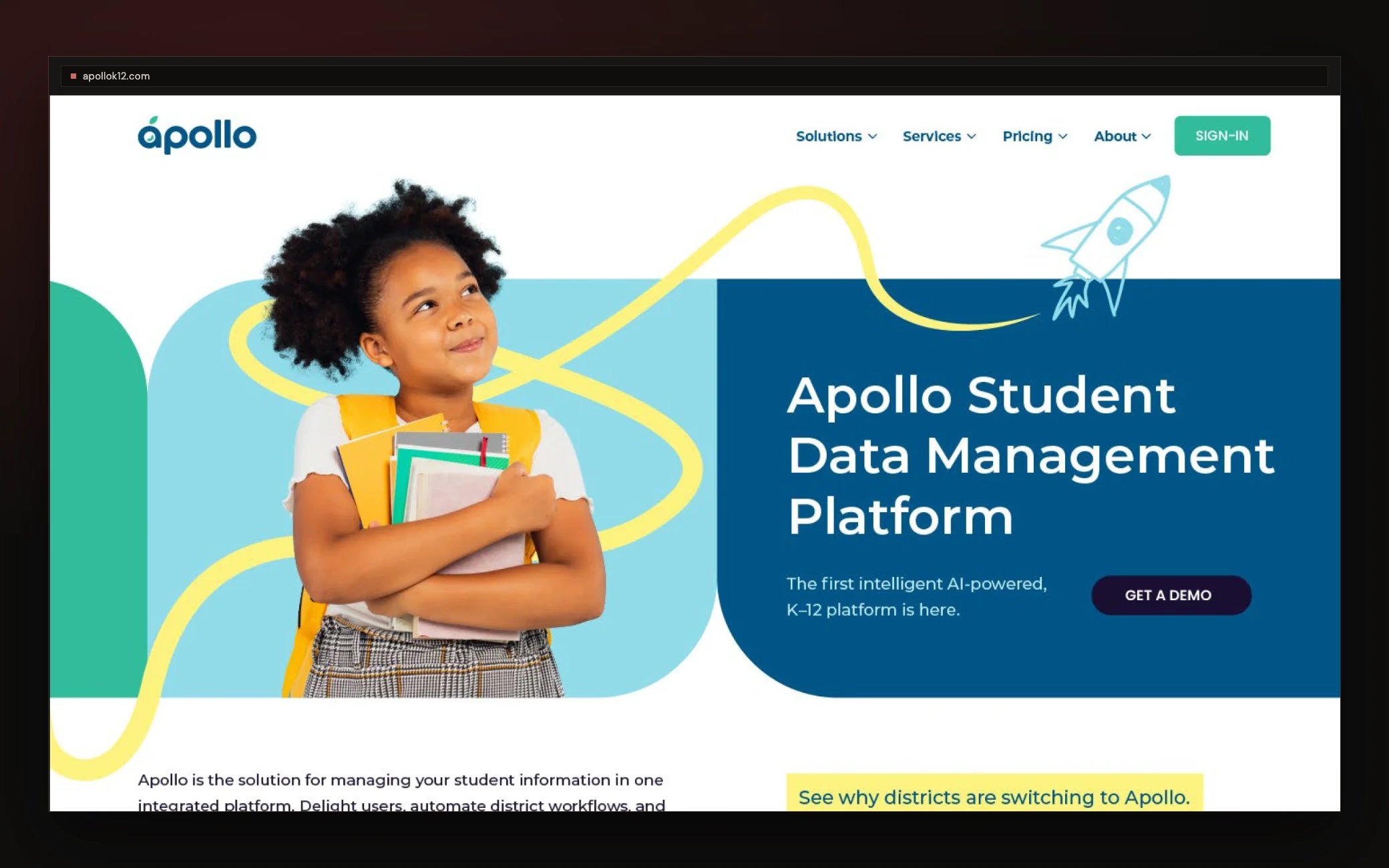
Education technology
ApolloK12
23 pages, custom PHP calculator, HubSpot API integration. Translated a complex Illustrator design into a fully responsive WordPress build. Launched on time.
-
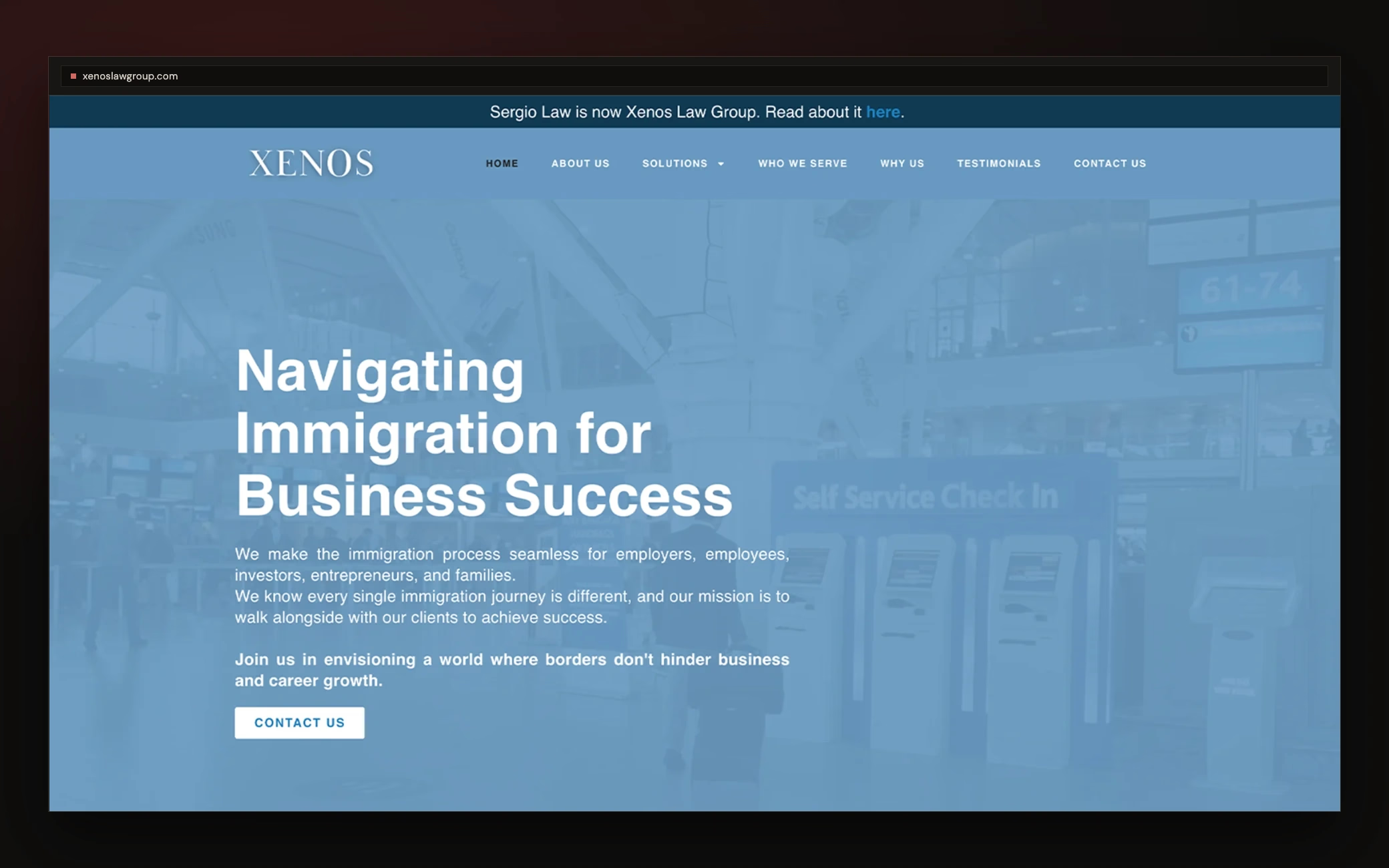
Immigration law
Xenos Law Group
Rebuilt from scratch after a bad experience with a previous developer. Designed in Figma, built in WordPress and Elementor Pro.
+42.7% Active users after launch
Want results like these?
If your website isn't doing your business justice, let's talk. No pitch, no pressure. Just an honest conversation about what's going on and whether I can help.